

In endpoint security, remediation typically means blocking - an action, a device, or an install. This can be incredibly aggravating for employees and lead them to flood security teams with tickets, use even less secure workarounds, or stick to efficiency-killing legacy solutions. And with more software being installed and more mission-critical work happening at the endpoint, a rapidly-growing remediation backlog is threatening to overwhelm security teams as tickets, CVEs, and alerts pile up.
As we designed Bloom, we asked ourselves: How do we create a remediation workflow that’s better suited to the ways organizations work in 2026? How do we scale remediation results without massively increasing security workloads? Eventually, this led us to a unique approach that uses the full capabilities of agentic AI to make better decisions, reduce busywork, and communicate with employees in a more personalized way.
The endpoint is back in full force. Manual remediation means drowning in tickets
The main challenge is that non-developers in departments like marketing and HR now download and install far more software than they used to, turning standard workstations into developer-like machines as they become 'citizen developers’. Tools for notetakings, transcription, and local automation are also exploding in popularity - both as standalone binaries, or as extensions to other desktop software. However, the major driver is AI.
AI agent harnesses like Claude Code, Codex, and Cursor rely heavily on the end-user's machine. While the agent calls APIs or uses the browser, it also installs new software by pulling in dependencies and libraries with very little human oversight to complete complex requests.
A finance manager, for instance, might know nothing about NPM, but knows how to prompt Claude. When asking the agent to analyze a batch of reports, Claude might install dozens of code packages in the background without them ever noticing.
Even security-aware developers struggle to track every single action an agent takes during a long-horizon task, let alone non-technical employees.
This creates several major problems when we think about remediation.
1/ The remediation workload is untenable
Remember when security teams had loads of spare time? Us neither. Security was always overstretched, always struggling to find time to hunt new threats amidst the flurry of business-as-usual: tickets, incidents, vendor reviews, audits… Now, the rise of the AI-native endpoint adds a ton of unwelcome daily noise:
- More tools being downloaded means more remediation decisions. You cannot possibly vet every app, extension, and code library in advance. (Unless you’re blocklisting everything, which your organization doesn’t want you to do - see below.) Instead, you will need to make many ad-hoc decisions.
- Every ad-hoc decision is complicated. Unless it’s actual malware, you’ll need context to make the decision: the risk level of the tool or package that the employee wants to use, what they’re trying to achieve, and what’s accessible through their endpoint. Then you need to weigh the business benefit versus the security risk.
- You need to field tickets after the fact. Employees tend to have very little patience when their computer refuses to do something, and seeing a generic ‘This action has been blocked by your system administrator’ message is little consolation. This frustration filters into tickets, which further distract from the main security mission.
2/ Employees find workarounds, which can be worse for security
A frustrated employee might not open a ticket. More enterprising individuals may simply look to circumvent your restrictions, in ways that end up creating even more work.
The wealth of new endpoint tools being released means that for every tool you block, employees can easily find a dozen alternatives. If you don’t allow a notetaker like Granola due to a compliance mandate, you might soon find yourself playing whack-a-mole as employees install one of countless alternatives, or attempt to use personal accounts to bypass security controls.
Employees with a modicum of technical inclination might even vibe code their own, always-on transcription tool - it’s basically one prompt away using the latest coding agents.
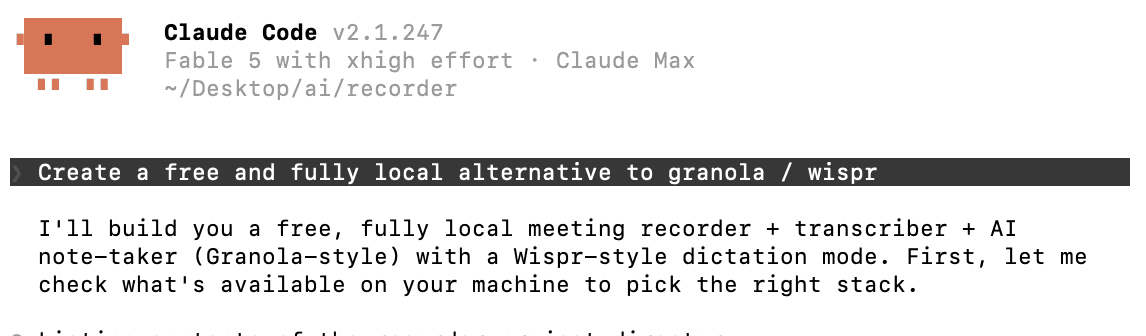
This pretty much worked
Many of these workarounds will be worse for security, and require more effort to detect, than the original offending application.
3/ You can’t just block everything
‘Block first, ask questions never’ is not really an option. Being overly-strict and locking down every install you’re uncertain about might be good for security, but lethal for your organization’s AI initiative - and your ability to retain top talent in an AI-native world. We are in a period of rapid change and experimentation, which most organizations want to embrace, albeit in a controlled and guardrail-ed manner. And as models and agents continue to improve, the incentives will go further in the direction of allowing more.
An AI-native, enablement-first approach to endpoint remediation with the Security Buddy
In thinking about the solution, it was clear that we need to address both sides of the problem: eliminating the busywork and tickets for the security team, while also removing the frustration that leads employees to create tickets and find workarounds. This is hard to do with the previous generation of rule-based automation, which by definition can only cover a limited set of contingencies. However, modern AI capabilities open new possibilities.
An AI agent can weigh specific context and make a more accurate ad-hoc decision, without necessarily requiring human intervention for low-stakes cases - context which we are already collecting as part of our ongoing risk analysis.
On the communication side, we can use conversational interfaces to turn remediation decisions into an experience that feels enabling rather than annoying - with the user being given better reasons for the decision, and some ability to “appeal” the decision without opening a ticket.
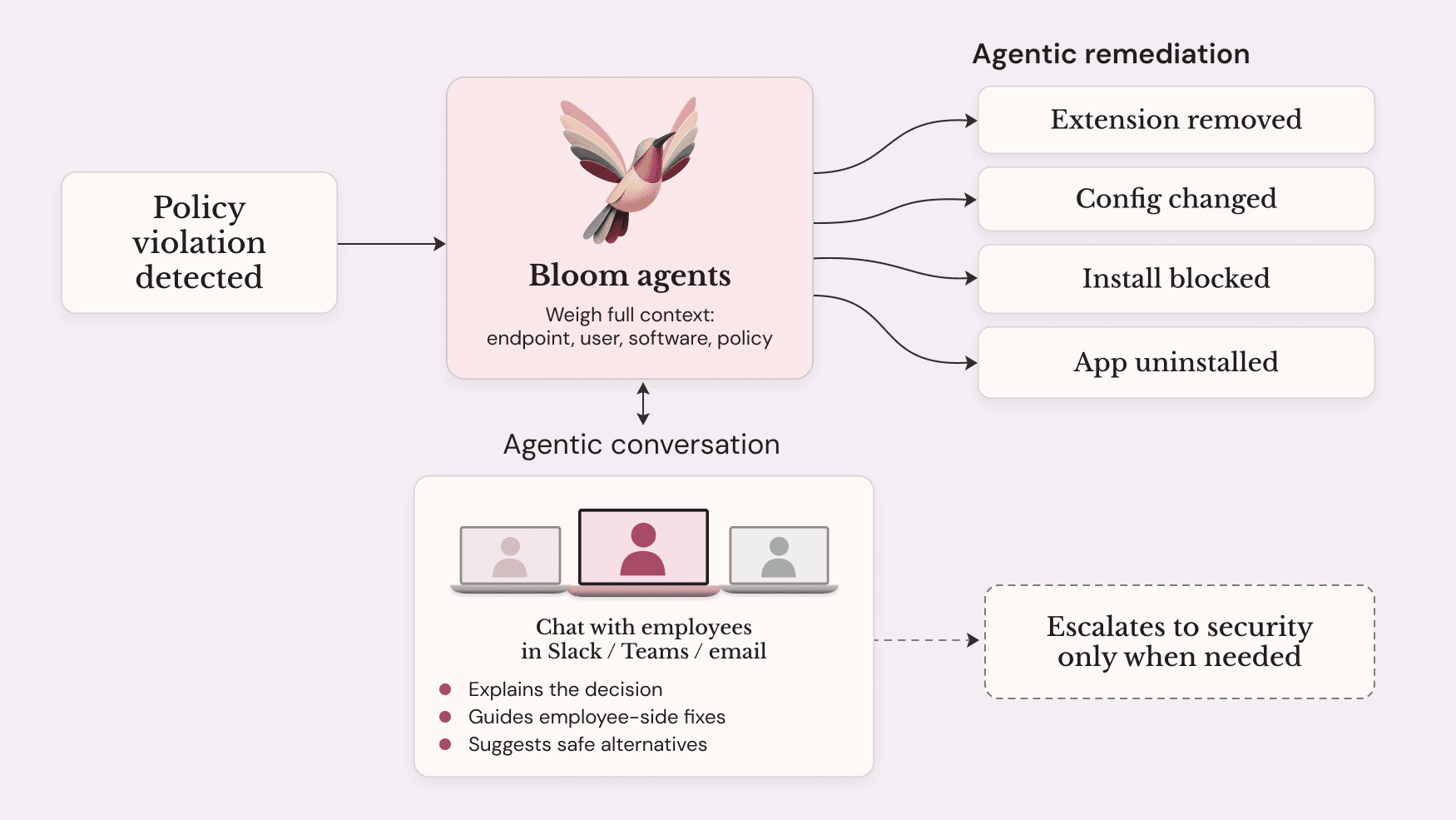
How it’s implemented in Bloom
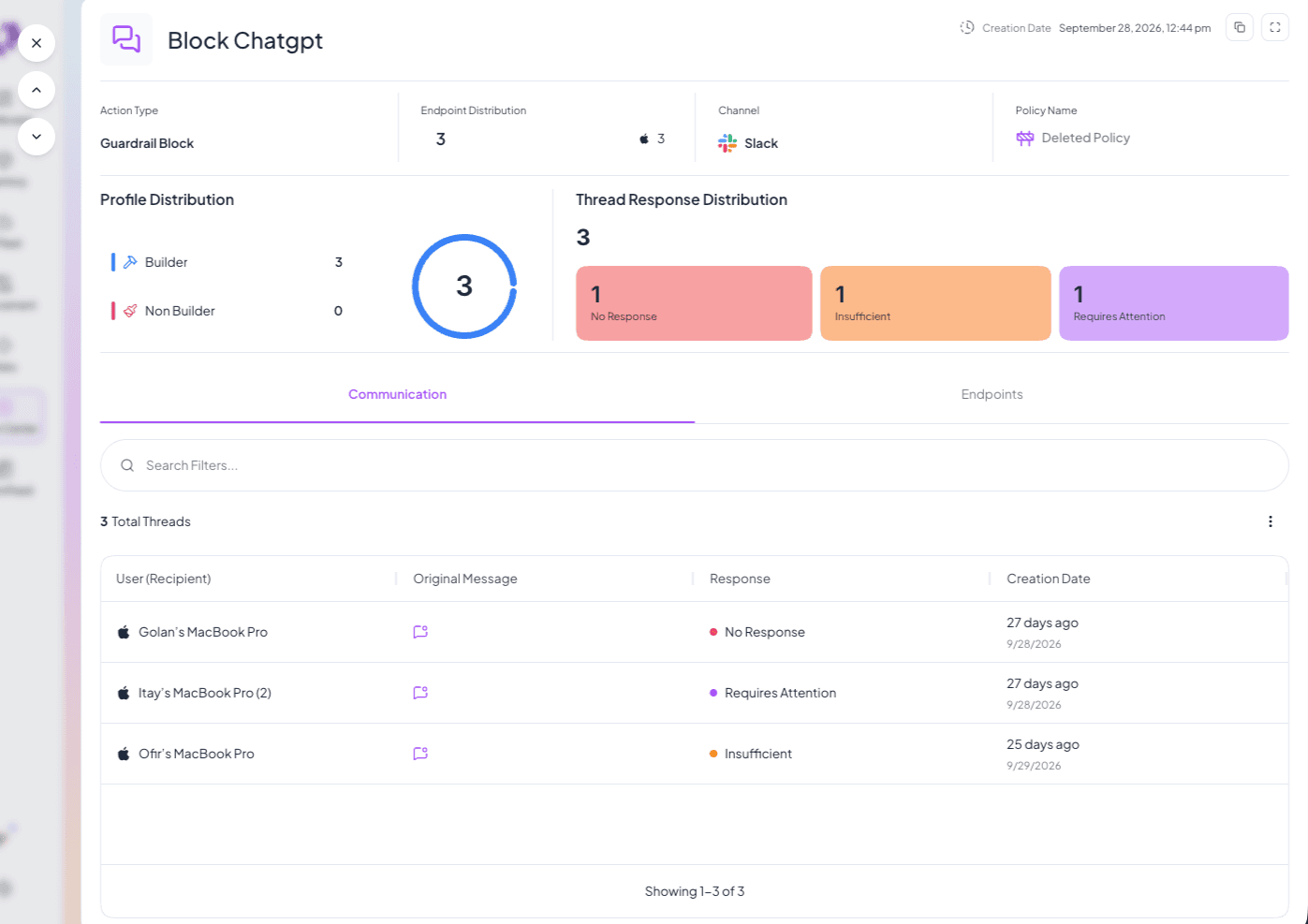
The Security Buddy is a specially-trained AI agent that pops up whenever a policy violation is detected. The agent appears where employees are getting work done - such as Slack, Teams, and email - and initiates an (optional) conversation.
Based on the user’s response and the way you have configured it, the agent will:
Explain automated remediation decisions, with the full context that Bloom collects about the endpoint, the user, and the infringing software. The user can understand why a decision was taken and request additional details - preventing the need to open a ticket, and discouraging workarounds.


Remediate the issue, by changing configuration in installed software, blocking software, removing a program completely, or removing an extension or plugin. The agent can take these actions autonomously or guide the employee on how to fix the issue - again based on the policies you have defined for groups of users, risks, or programs.
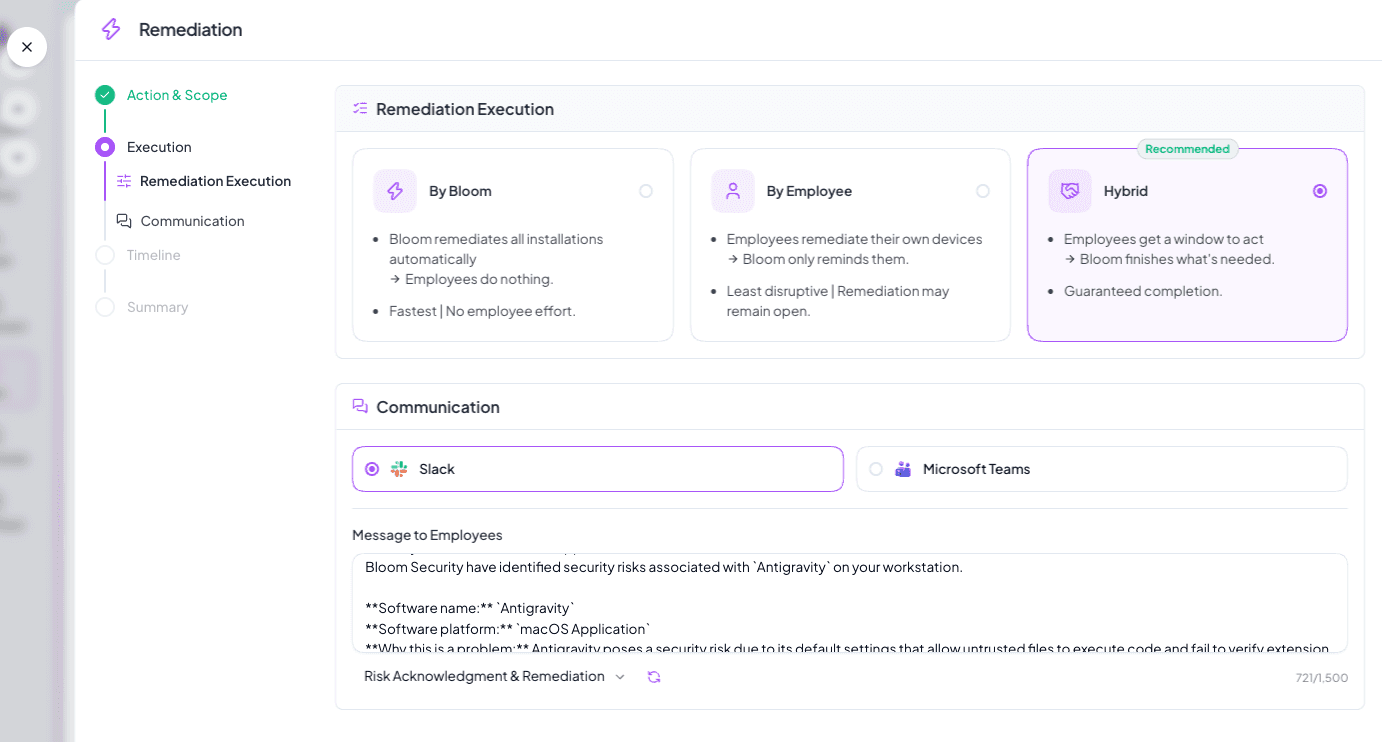
Escalate and bring the security team into the fold, at any point, based on the agent’s evaluation of the employee’s dispute and explanations.
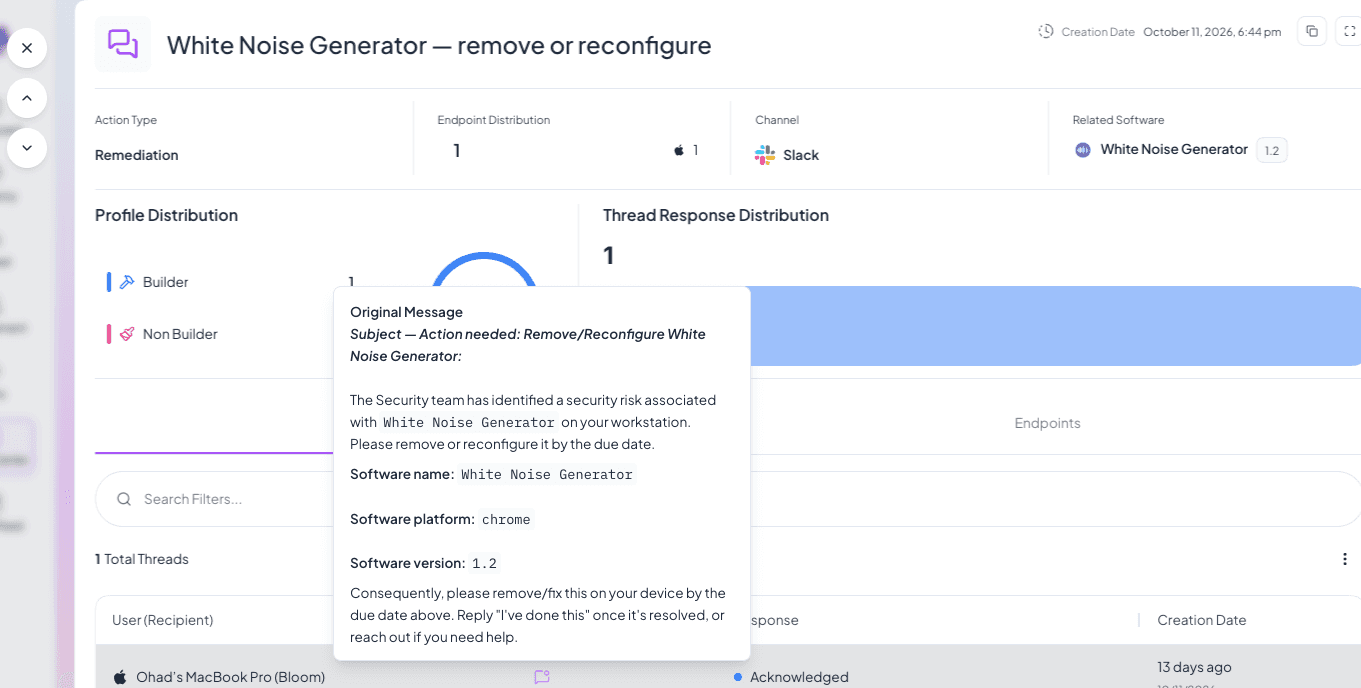
The policy is enforced either way. The agent is not authorized to change the decision (and is prevented from doing so through deterministic guardrails). The conversation helps to contextualize the decision, collect additional information, and guide the employee.
What are the advantages of this approach?
- Repetitive work is handled by agents, not humans. By incorporating conversational AI into the remediation workflow, the Security Buddy automates investigation work and escalation decisions that used to require human intervention at every step - saving time and helping security teams to adapt to a growing remediation workload.
- Less frustration and fewer tickets to deal with. The agent handles many disputes and appeals that would ordinarily become tickets (or just angry Teams messages). The employee understands what went wrong, and can get suggestions on how to achieve their goals in a security-approved way. Since the conversation is informed by Bloom’s contextual analysis, it feels like a personalized chat with an informed security expert - rather than a faceless verdict delivered by fiat. Instead of opening a ticket, employees find security-approved ways to keep working.
- Better security decisions that enable innovation. The agent collects additional information that allows for more fine-grained decision making with fewer blanket bans - ultimately helping security deliver on the mandate to support innovation and experimentation.
Raising the bar for endpoint remediation
Early customers are already using the agent to close remediation loops that used to take days of back-and-forth - including risky browser extensions, unsanctioned AI tools, and vetting agent-installed libraries for known CVEs. Customers are seeing anywhere between 27% to 60% fewer remediation-related tickets, with the agent fielding the majority of the communication work and less than 20% of conversations escalated to a human analyst, on average.
As with most AI tools, context is what makes the difference. The reason our customers see these results is not that employees get explanations in natural language. It’s because these explanations are very much grounded in the employee’s reality, rather than generic CVEs and security-speak that business users might find incomprehensible.
Moving forward, we will look to further enrich and tailor the context that Bloom derives for each endpoint environment. We will also be iterating on the reasoning loops, with the goal of enabling the agent to handle more remediation decisions autonomously.
If you’d like to see it in action, get in touch with our team for a demo.